|








|
|
The text used in this composition is an excerpt from the Anne Frank's diary
written in 1943 at the age of 14. It refers to her former school friend, Lies
Goosens, who had been transported to a concentration camp during the Nazi
persecution of Jews, while the Frank family was hiding in Amsterdam for two
years by courageous Dutch friends. Anne's grief over her friend's fate and her
fervent prayer for her safety form the poignant text of Morawetz's composition.
Following the information of a collaborator, the whole Frank family was arrested
in August 1944 and shipped to the extermination camp in Auschwitz. The betrayer
of the secret hiding place received from Hitler's Secret Police the usual reward
of five gulden ($1.40) for each member of the Frank family. Only Anne Frank's
father, Otto, survived the terrible starvation and suffering of the camp life.
|

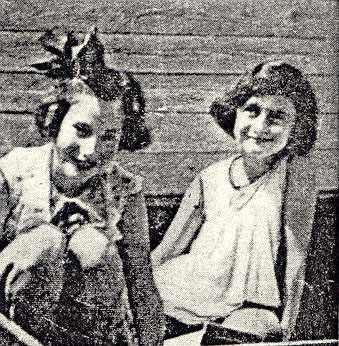
Lies Goosens and Anne Frank in school before the war. |
During the swift advance of the Allied Armies in the winter of 1944, Anne and her sister,
Margot, were shipped to their final destination, the Belsen Camp in Germany.
There Anne accidentally met her friend, Lies Goosens, about whose fate she had
worried so much worried in her diary. Lies survived miraculously the horrors of
the prison camps. About her meeting with Anne in March 1945, the last month of
Anne's life, she recalls:
|
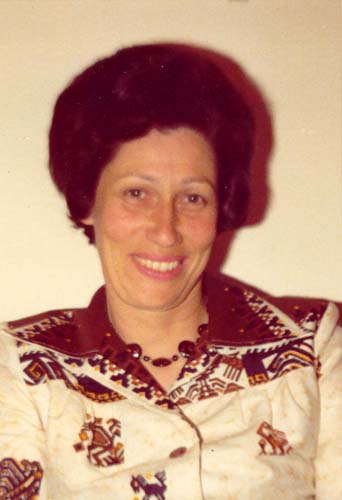
Lies Goosens, 1976 |
"I was shivering in darkness when I suddenly heard a voice; 'Lies, Lies
where are you?' It was Anne, and I ran in the direction of the voice, and then I
saw her beyond the barbed wire. She was in rags. I saw her emaciated, sunken
face in the darkness. Her eyes were very large. We cried and cried, for now
there was only the barbed wire between us, nothing more. And no longer any
difference in our fates.
"I told Anne that my mother had died and my father was dying, and Anne told
me that her mother died and that she knew nothing about her father. Only her
sister, Margot, was with her but she was already very sick and died a few days
later. Anne was not informed of her sister's death; but after a few days she
sensed it and died soon afterwards -- only seven weeks before the end of the
war. She was not yet 16."
When Morawetz wrote the Diary, he realized that as the text was
written so recently, he would have to get permission to use the words in his
composition. As the composition was almost completely finished, he was very
nervous that this permission may not be granted. Instead of writing a
business-like letter to the publisher of the diary, Doubleday, he decided to write a very personal,
impassioned note about how much the diary meant to him. In hindsight he was
relieved to have crafted such a polite letter when the publisher replied that he
could not give permission to Morawetz as the father of Anne Frank was still alive,
and he has taken the liberty of forwarding Morawetz' letter to him.
 Click here to read Doubleday's reply
 May 15, 1990. CKDU-FM Halifax:
Morawetz
describes how he obtained permission to
use the words from the Diary.
May 15, 1990. CKDU-FM Halifax:
Morawetz
describes how he obtained permission to
use the words from the Diary.
|

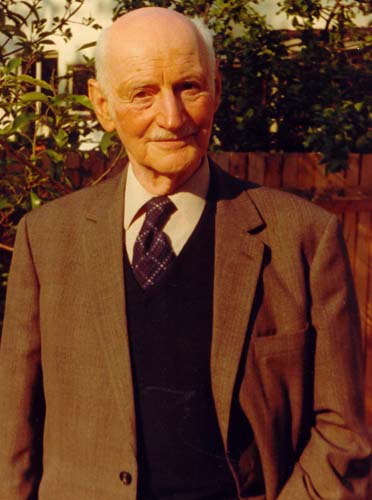
Otto Frank |
Permission was granted to Morawetz, and a long-time friendship and
correspondence developed
between him and Otto Frank. When Morawetz asked what had happened to all the
other people who had helped hide the Frank family, Mr. Frank informed him that
Miep and Elly, the two secretaries that helped bring food and other essential
items to the eight people hiding in the attic were living in Holland; Lies, about whom Anne writes in the excerpt used in
Morawetz' composition lives in Jerusalem, and Mr. Kraler (whose real name is
Victor Kugler) lives, in all places, in Toronto! Here is the letter that Mr.
Frank wrote to Morawetz disclosing this information:
Letter from Otto Frank, Feb. 24, 1970
|
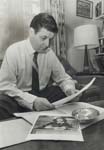
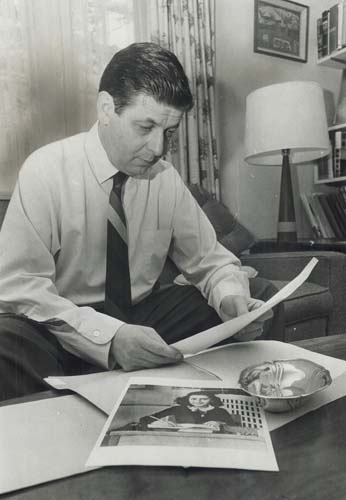
Photo: Doug Griffin |
Morawetz invited Mr. Kugler to
the première performance of the Diary, where he presented flowers to soprano Lois Marshall on
behalf of Otto Frank. On the occasion of the première, Mr. Frank sent Morawetz
the following letter as well as a silver dish, one of the few possessions he had
saved from the war. Much to Morawetz' dismay, the dish seemed to have gone
missing during his divorce.
Letter from Otto Frank, May 14, 1970
Morawetz visited Mr. Kugler and his wife often, and invited Mr. Kugler to
Toronto performances of his composition, where he would surprise the audience by
presenting Mr. Kugler to an often emotional audience.
In 1973, Morawetz travelled to Switzerland and met Otto Frank for the first
time, at his home in Basel. During their visit, Morawetz lamented the fact that
he had not brought a tape recorder whereupon Otto Frank offered his own cassette
machine, and Morawetz recorded a conversation with Mr. Frank. Below are excerpts
from the recorded conversation on May 29, 1973 between Morawetz and Otto Frank:
Dr.
Morawetz, I am so glad to have you here in our home. We had such a long
correspondence ...
As a
matter of fact, one of the questions which people ask me again and again is if
you have seen any part of the diary while you were in hiding ...
I presume,
Mr. Frank, when you read the diary after the war that many things must have
been quite surprising for you...
Not only
the brother of Mr. Koophuis knew everything, but also his wife. And she came
several times to visit us. It was different with Mr. Kraler. His wife...
Mr. Frank,
although we all know, of course, very well the diary, there is very little
known what happened when you came to Auschwitz...
In the camp
there was different work, of course. There was very difficult
work and there were also posts which were easy. And Peter was at the post
office, one of the most easiest jobs anyone could have in the camp. And as
there were many parcels received...
Mr. Frank, were you very surprised when you suddenly got from me the letter
that I want to set in music one of the most moving letters which I found in
the diary?
In 1976, the Diary was performed in Tel Aviv. Morawetz and his
daughter travelled to Israel for the performance, and then spent a week touring
Jerusalem. After many failed attempts to contact Anne Frank's childhood friend,
Lies, the subject of the diary excerpt which Morawetz set to music, Morawetz finally
arranged to spend his last evening in Jerusalem with her. Lies was
somewhat reluctant to talk about the horrors of the past, but gave Morawetz her
only copy of an article she had written for a magazine shortly after the war:
May 15, 1990. CKDU-FM (Halifax):
Morawetz
describes his meeting with Lies, and retells the story of Anne and Lies' last
encounter in the Bergen-Belsen concentration camp.
During the same 1976 trip, Morawetz once again visited Otto Frank in his home
and met Miep Gies, one of the secretaries who helped to hide the Frank family,
and who was visiting Mr. Frank at the time.
Two years later, Elly van Wyck, the second
secretary who helped bring food, comfort and outside news to the Frank family while they
were in hiding, visited Mr. Kugler from her home in Holland. Morawetz was
invited to meet her, completing his association with all the surviving members
of the "Anne Frank" story. During his visit with Elly in Mr. Kugler's
home on Oct. 9, 1978, Morawetz asked Elly a few questions:
Did you
know Anne already before she went into the hiding? When did you meet her...
As it was
very dangerous to spread the secret about the hiding place, did anyone in your
family know...
In the remainder of Morawetz' interview, Elly responds in her native Dutch, and
translation is provided by Mr. Kugler's wife, Lucy.
As you
knew Anna very well, when I read the diary, I saw that sometimes she was
terribly depressed...
How much
do you think she knew about the terrible things which happened outside...
When the
gestapo came and arrested the whole Frank family, have you seen the gestapo when
they came in...
Have you
ever been back in the office after you escaped luckily from the Gestapo? ...
When you
finally did go back, did you go just for a short visit, or did any work continue
after...
And what
happened with the diary? I hear Miep came back and saved it?
Did you
ever read the diary after you saved it before the end of the war?
When did
you see Mr. Frank the first time after the war?
Elly if
you would be so good and still describe me your impression of all the other
people who were in the hiding...
And
Margot, was she similar like Anne, or very different?
And Mr.
Van Dusssel, whom Anne disliked so much in her diary - how did you find him?
This man
in the basement about whom everybody was suspecting that he really gave the
gestapo the secret...
When the
arrest finally came, did you then tell your brothers and sisters and your
mother,...
Photos of the survivors from the "Anne Frank" story:
|
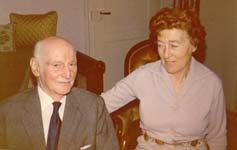
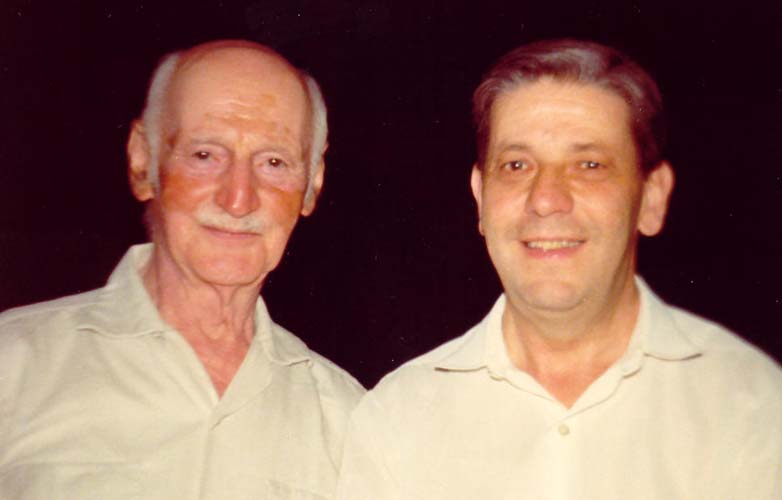
Otto Frank with his second wife, Fritzi, at Morawetz' first meeting with him in
Frank's home in Basel, Switzerland, 1973.
|

Otto Frank, England, 1975 |
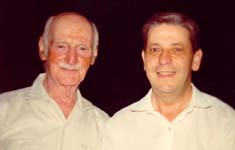
Otto Frank and Morawetz, Basel 1976 |
|
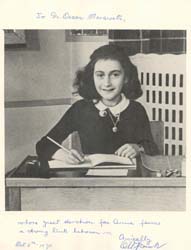
Anne Frank
Dedication:
To Dr. Oscar Morawetz, whose great devotion for Anne forms a strong link
between us.
Amically, Otto Frank. Oct. 5th 1970. |
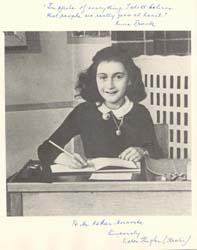
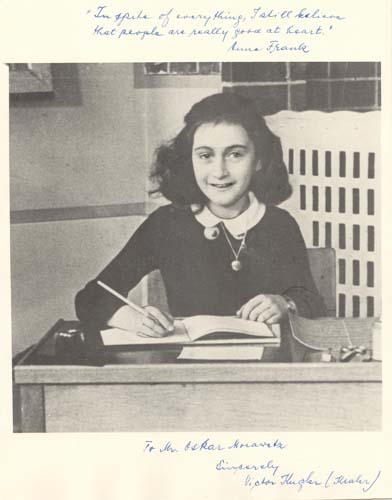
Anne Frank
Dedication:
"In spite of everything, I still believe that people are really good at
heart" Anne Frank
To Mr. Oskar Morawetz,
Sincerely Victor Kugler (Kraler) |
|
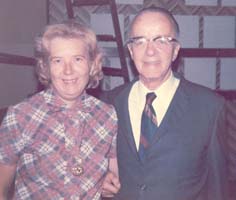
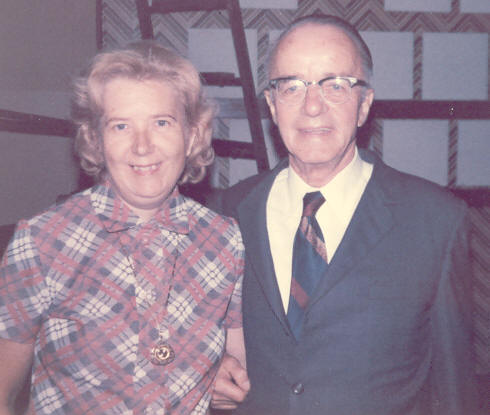
Lucy and Victor Kugler, 1973 |
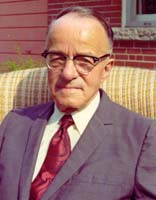
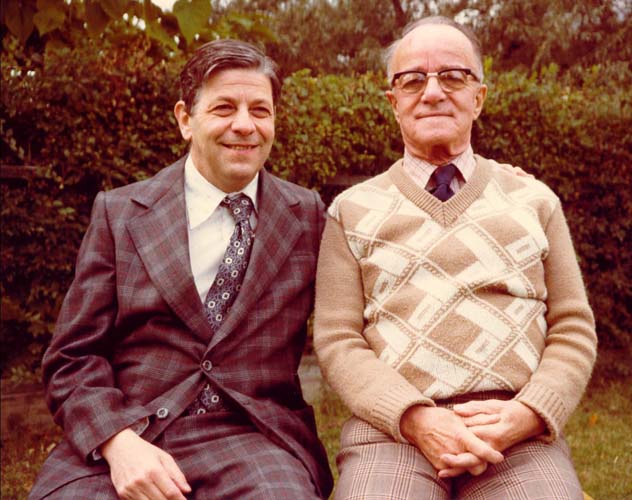
Victor Kugler |
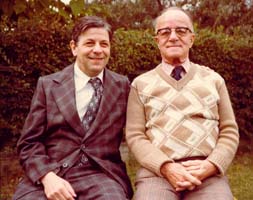
Morawetz and Victor Kugler, 1978
|
|
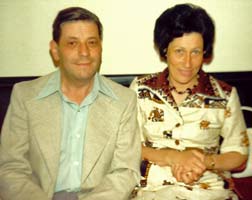
Morawetz and Lies, 1976
Lies Goosens was Anne's best friend from school |
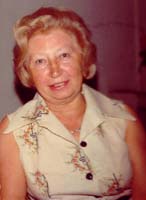
Miep Gies, 1976
Miep was one of the two secretaries that helped to hide the Frank family |
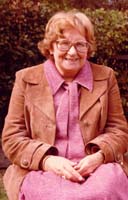
Elly van Wyck, 1978
Elly was one of the two secretaries
that helped to hide the Frank family |
Additional background material:
|
|