|






|
|
Memorial to Martin Luther King
2003
Canadian Winds, Spring 2003, vol.1, no. 2 by Timothy Maloney
Reprinted with permission from the author
SPOTLIGHT ON CANADIAN REPERTOIRE
Oskar Morawetz’s Memorial
to Martin Luther King
For Solo Cello and (Wind) Orchestra
by Timothy Maloney
“Don’t write a concerto, or a work with the usual form or
content, or with the standard-sized orchestra.”[1] This was the challenge from Mstislav Rostropovich
to Oskar Morawetz in 1966 when the Russian cellist (later the conductor of
Washington, D.C.’s National Symphony Orchestra) asked the Czech-born, Canadian
composer to write a new work which he hoped to premiere upon his return to
Canada. When Morawetz pressed him to
explain more clearly what he wanted, Rostropovich replied that he would trust
the composer’s imagination to work out all the details.[2]
Later the same year, the cellist was back and asking to see
the new composition. At that point,
Morawetz had developed only a few sketches, none of which he considered worth
pursuing. As more time passed, he worried about finding a workable solution to
Rostropovich’s intriguing commission.
Then inspiration struck.
In April, 1968, as
Morawetz watched television coverage of the funeral of Dr. Martin Luther
King, the assassinated American civil-rights leader, “the idea suddenly struck
me to write for Rostropovich a work
dedicated to the memory of King…[W]hen I saw on the screen King’s gravestone
with the inscription of his favourite spiritual (‘Free at last; thank God
almighty I am free at last!’)…I saw clearly in front of me the form, content,
and orchestration of my composition.”[3] It would depict the Freedom March in Memphis
which King had helped organize and lead, the fatal gunshot, and his funeral
march, which would be based on the spiritual whose words were engraved on his
tombstone and which he had quoted at the end of his famous “I have a dream”
speech in Washington,. D.C. in 1963.
As Morawetz saw it, “The complete exclusion of any string
instruments in the orchestra would give the work a specially dignified and
dramatic colour, and at the same time solve Rostropovich’s wish for an unusual
orchestration.”[4] The only impediment to starting work was
that Morawetz could find no-one in
Toronto who knew the melody to the spiritual.
He eventually telephoned the
opera singer, Dorothy Maynor, in New York.
He had known her since 1949, when she sang several of his compositions
in North America and Australia. She was
able to sing the spiritual for him over the phone, and he set right to
work. Three months later the composition
was finished.
The world premiere was scheduled to take place in February
1970 with Rostropovich and members of the Edmonton Symphony Orchestra, but
illness forced the cellist to cancel his entire North American tour that
winter, so the work was eventually premiered by the Canadian cellist, Zara
Nelsova, with the winds and percussion of the Montreal Symphony Orchestra. Nelsova and the MSO were featured on the
first commercial disc of the work, released by Radio-Canada International (RCI
213-A).
On January 15, 1979, which would have been King’s fiftieth
birthday, the Nelsova-MSO recording was broadcast on radio stations in
thirty-six countries, including Argentina, Australia, China, Korea, and the
Vatican, which itself broadcast the work several times throughout Europe. It has been performed over forty times in
the USA, Canada, and Europe, and is now in the repertoire of seventeen renowned
cellists.[5] Yo-Yo Ma has performed it extensively,
including with the New York Philharmonic and the Toronto Symphony Orchestra,
and the Canadian cellist, Shauna Rolston, has played it in Canada and the USA
and recorded it with the Edmonton Symphony Orchestra (CBC SMCD-5105).
Such a wide international audience is not unknown to Oskar
Morawetz, though it is to many other Canadian composers. His works have been performed by many
prominent musicians, including the pianists, Glenn Gould and Anton Kuerti; the
singers, Maureen Forrester, Lois Marshall, Louis Quilico, and Jon Vickers; and
the conductors, Karel Ancerl, Sir Adrian Boult, Raphael Kubelik, Zubin Mehta,
and Seiji Ozawa, among others. His
orchestral music has been performed by more than 120 orchestras on five
continents, and his compositions have appeared on Columbia, RCA Victor, and EMI
recordings, as well as the Canadian Music Centre’s label, Centrediscs.[6]
Morawetz, who turned 86 on January 17 of this year, is a
self-avowed traditionalist who taught music theory and composition at the
University of Toronto 1946-82. His
idiom is a tonal, post-romantic one which he evolved alone through personal
study of scores by some of the more conservative composers of the twentieth
century (e.g., Bartók, Britten, Richard Strauss). He was never attracted by avant-garde trends and has consistently
maintained that “there has to be some kind of melodic line.”[7] The numerous honours, prizes, and awards he
has received, including the Order of Ontario, Order of Canada, and Junos for
his Concerto for Harp and Chamber
Orchestra and From the Diary of
Anne Frank, a Juno nomination for the Memorial to Martin Luther King,
and two major awards from the Society of Composers, Authors and Music Publishers
of Canada (SOCAN) speak to the accessibility and impact of his music, and to the
high regard in which it is held.
The Memorial to Martin
Luther King is one of a number of works on the theme of death in Morawetz’s
output. These include the Sonata Tragica (1945) and Fantasy,
Elegy and Toccata (1958) for piano; the Passacaglia
on a Bach Chorale (1964), dedicated to John F. Kennedy, and reflections After a Tragedy (1969) for orchestra; the Symphony No. 1 (1951-53) and
Sinfonietta for Winds and Percussion (1965),
the slow movements of which are both entitled Elegy; and From the Diary of Anne Frank (1970) for soprano and orchestra.
The Memorial to Martin
Luther King is scored for basically double woodwinds, triple brass (though
four horns and one tuba), timpani, percussion, harp, piano, and celesta. By excluding any other strings from the
accompanying ensemble, the composer has given the solo cello a unique
instrumental voice against the colours of the woodwinds and brass, and
virtually all the expressive potential, while imbuing the accompanying ensemble
with the elements of power and drama.
(Morawetz is not the first composer to arrive at this solution: for example, the French composer, Jacques
Ibert, wrote a Concerto for Cello and
Wind Instruments in 1926.) Morawetz’s
is a programmatic work (i.e., based on an extra-musical association) in a
single movement, with four separate tempi
in eight sections.
The solo part is technically demanding and requires a
cellist of professional calibre. The
wind ensemble writing, as might be discerned from the names mentioned above of
some of the ensembles that have performed the work, requires at the minimum an
accomplished group of university-level musicians.
The work begins Adagio
pesante with strong, dissonant chords in the brass, accompanied by dramatic
rolls in timpani and piano meant to convey “shock and dismay at the turn of
events.” A pedal B-flat which sounds
throughout this section returns later to dominate the final three sections of
the work (see Musical Example 1).
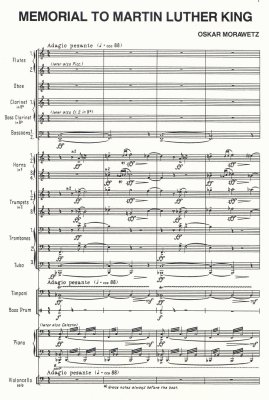
Musical Example 1: First page of score to Oskar Morawetz’s Memorial to Martin Luther King, showing
the dramatic opening scored for brass and percussion, including piano, with low
bassoons.
The solo cello enters with a long, expressive melodic line
which the composer has likened to a “sorrowful meditation.” It is chromatic and meandering, at first
exploring the lowest reaches of the cello range, later rising into the treble
clef (see Musical Example 2). Reduced ensemble resources and a subdued tone in the
accompaniment ensure dominance by the solo instrument. Dark, low colours are scored in the winds
while bass drum and timpani remain quietly insistent. Brief chromatic interjections from woodwinds and brass complement
the unsettled tone.
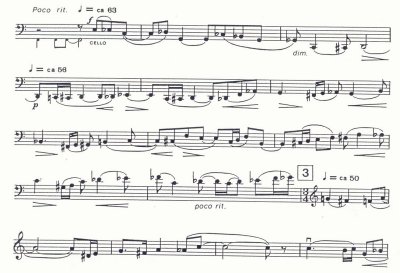
Musical Example 2: The first eleven measures of the cello part
in Morawetz's Memorial to Martin Luther King.
The next section, beginning at rehearsal number [11],
depicts the so-called Freedom March undertaken by King and many of his
followers in Memphis, Tennessee, on what was to be the last day of his
life. This Allegro marciale begins, in the composer’s words, with “ a nervous
marching rhythm” in the piano. The
music here has a purposeful, outgoing quality.
A tense, rhythmic dialogue develops between cello and winds utilizing
off-beat rhythms and a gradually rising solo line.
Growing steadily in dynamic and rhythmic intensity, the
music approaches the climactic point with low trombones projecting menace and
foreboding. The fateful gunshot is
rendered musically by bass drum, timpani, whip, and a tenor-drum rim-shot. There follows a dramatic orchestral
interlude, symphonic in scope, that develops material from the opening of the
work and reaches a climax at [37]. The adagio tempo of the opening returns as
this section subsides in a gradual diminuendo
and fall in tessitura.
The cello re-enters with a second meditation based on linear
material from the first one. This
section is a variation featuring different harmonies, orchestration, and the
transformation of melodic and rhythmic ideas.
Through much of the episode, the solo instrument is accompanied only by
woodwinds and pitched percussion (celesta, vibraphone, and bells) in a subdued
expression of grief.
The following section, beginning at [47], portrays the
funeral procession. Winds and
percussion intone a sombre, dirge-like setting of the spiritual, “Free At
Last.” Woodwinds and brass alternate
phrases of the song antiphonally in a polytonal harmonization (see Musical
Example 3), while the E-Major melody is juxtaposed throughout with the B-flat
pedal-tone of the work’s opening (a tritone relationship), preventing consonant
resolutions at the phrase endings and carrying forward the feelings of sorrow
and distress which have characterized the composition to this point.
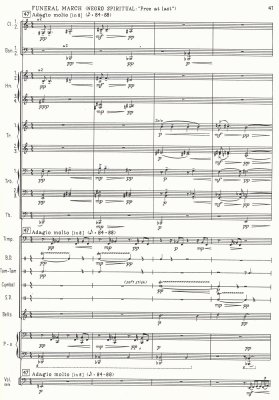
Musical Example 3: Morawetz’s harmonization of the Spiritual,
“Free At Last,” beginning at [47] in Memorial
to Martin Luther King.
The lack of repose at the end of each phrase of the
Spiritual gives opportunities for the cello to interpose restless, lamenting
lines of its own. Rather than joining
the wind ensemble as it intones the phrases of the spiritual, the cello enters
between each phrase, extending the cadences in a twentieth-century version of
Baroque sighing motives to express the grief of the mourners.
A second ensemble interlude ensues at [54] in which brass
and percussion develop fragments based on the last three notes (“free at last”)
of the spiritual. The ensemble rises to
a peak of tension before subsiding on a softly sustained chord: the pedal B-flat now expressed as a full
harmony, Bb-Eb-Ab-C. Over this hushed
sonority, the cello plays an undulating line that rises from its lowest note up
three-and-a-half octaves in a conceit similar to that used by Richard Strauss
at the end of his tone poem, Ein
Heldenleben, where the soul of the hero is depicted rising to heaven (see
Musical Example 4).
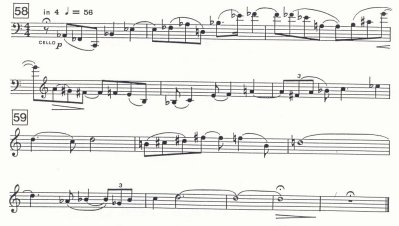
Musical Example 4: The final thirteen bars of cello solo,
beginning at [58], during which it climbs 3½ octaves.
In the last few measures, the pedal-chord alternates between
woodwinds and vibraphone while a grouping of flute, bells, and piano sustain pianissimo dissonances against it. The high-pitched, ethereal colours of this
combination bring to mind another Straussian felicity, the “rose motive” from Der Rosenkavalier. The work concludes in an atmosphere of
“peace and resignation.”
Upon close examination, one finds the fabric of the entire
composition infused with elements of the spiritual. For instance, the brass rhythm that opens the work ( ) virtually mirrors the most prominent rhythm of the
spiritual, found at both its beginning and end (on the words, “Free At
Last:” ). The major triad (Bb-D-F) played by the First
Horn in bars 1-2 (see Musical Example 1 above) corresponds to the major triad
that begins the spiritual. The descending
three-note group played by the First Trumpet (bars 2-3) (Gb-F-Eb), is an
augmented version of the fourth bar, first phrase, of the spiritual. Both orchestral interludes are based on
prominent intervals in “Free At Last:”
the second one, beginning at [54], has already been discussed
above. The earlier one, portraying
King’s “Freedom March,” develops the interval of the fifth in both open and
filled-in forms. The first cello entry
employs the major triad referred to above, as well as “blue” notes, an integral
part of the African-American spiritual tradition (see Musical Example 2 above
for examples of the flat third, fifth, and seventh scale degrees, commonly known
in jazz parlance as "blue" notes).
Beyond the evident use of the spiritual as the basis for the
composition, Morawetz shows allegiance to no standard “school” or tradition of
composition in this work. Its harmonic
vocabulary includes a complex amalgam of extended tertial, quartal, and
whole-tone sonorities, often with dissonant, “colour” notes added. The idiom is chromatic, though rooted in
major-minor tonality, and seemingly derived from the advanced tonality of
Reger, Strauss, and the post-Romantics.
There are no melodic themes employed in the tradition of
eighteenth- and nineteenth-century sonata-allegro structure. Certain motives and intervals are
recognizable throughout the work, and the method, if any, resembles that of the
Finnish composer, Jean Sibelius. In a
reversal of the traditional process of disassembling melodies exposed at the
outset of a movement and “developing” their constituent parts, he gradually
“assembled” fragments exposed early in his symphonic movements into full-scale
themes. Here the full quotation of “Free
At Last” late in the composition may be said to coalesce out of the various
motives and intervals on which the composer based earlier parts of the work.
The linear element of the composition moves predominantly by
step and small intervals. The long,
spun-out lines belong at the opposite end of the musical spectrum from the
clear-cut phrasing of Classicism, more akin to Baroque fortspinnung (“spinning out”) or the long-breathed,
early-Renaissance melodic style of Johannes Ockeghem. Within these lines, motives are developed through sequential
repetition, the gradual enlargement of intervals, and an often-rising tessitura. As evinced by his linear writing, Morawetz’s compositional
process seems concentrated along broad lines and large-scale musical form, both
of which are related in this composition
to the program (i.e., the depiction of real-life events).
The sequence of eight sections is arranged to give maximum
contrast and variety to the work: high
emotion and volume at the outset, a subdued solo lament, the march’s measured
pace, the drama of the gunshot and ensuing orchestral outcry, a second solo
episode, the quiet but unsettled spiritual, and the final orchestral section
purging earlier emotion and drama before the serene, almost mystic, ending.
One music critic, Eugene Cramer, formerly the head of the
Music Department at the University of Alberta, has described Morawetz’s Memorial to Martin Luther King as “one
of the best contemporary works I have heard and which in time should rank with
the Berg Violin Concerto as one of
the monuments of 20th-century music of its kind.” Although its programmatic nature might be
construed by some as naïve in comparison to the objective detachment exhibited
in so much twentieth-century repertoire, the proof of this composition’s
ability to move audiences is in the hearing.
A singular specimen in the Canadian
wind-ensemble literature, it has achieved the wide circulation and
attention that many composers hope for but do not manage to achieve. Since the institution of an official holiday
in the USA to commemorate King’s achievements (the Monday nearest January 15,
his birthday), and the plethora of public events surrounding the holiday, the
likelihood is high that this work will receive many future performances.
[1] Oskar Morawetz, “Thoughts on Memorial to
Martin Luther King,” Toronto Symphony
News 6, 1979/80, p. 2.
[5] David Parsons, “Memorial to Martin Luther
King,” Notations 5/1 Winter 1993, p. 6.
[6] Roxanne Snider, “Oskar Morawetz at 75,” Classical Music Magazine, April 1992, p 19.
[7] Canadian Music Centre, Directory of Associate Composers, “Dr. Oskar Morawetz:”
|
|


