|

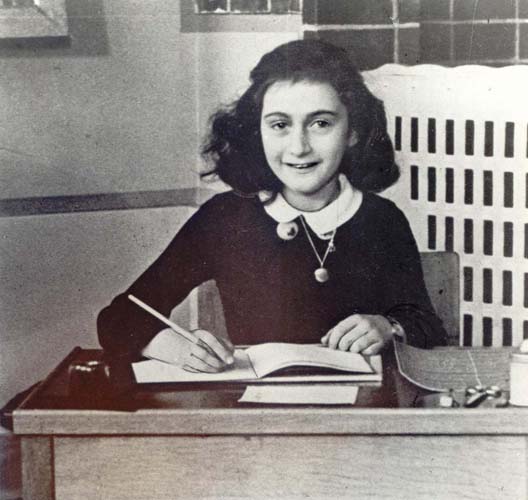
Anne Frank |
It was not until 1967 that Morawetz finally read Anne Frank's poignant diary. So
struck was he by the beauty of it, he determined then and there to set a portion
of it to music.The meditative nature of the text is reflected in the lyrical
qualities of the music, reinforced by an orchestration emphasizing the "magical"
colors of harp, celesta and vibraphone. The dramatic sections use a highly
chromatic language with chords of perfect fourths, augmented fourths and major
sevenths. This idiom is contrasted with the pure triads of Anne's prayer.
Morawetz' composition is a three-part dramatic scena for voice and large
orchestra. His expressive harmonic and melodic language, based on triads a
tri-tone apart, mirrors the anguish and tension of Anne's words.
The music starts with mysterious, high-pitched chords at the opening
sentence:
Yesterday evening, before I fell asleep who should suddenly appear before
my eyes but Lies.
This is followed by a sorrowful phrase in the oboe and trumpet
which later plays an important part in the development section of this work.
Suddenly, this mood is superceded by dark colours at the words:
I saw her in
front of me, clothed in rags, her face thin and worn. Her eyes were very big
and she looked so sadly and reproachfully at me that I could read in her
eyes: "Oh, Anne why have you deserted me? Help, oh help me, rescue me from
this hell!"
Though Anne lived for two years with the constant danger that her
hiding place might be detected, she felt almost guilty about her own relative
safety.
Oh God, why should I have all I could wish for and why should she be
seized by such a terrible fate. I am not more virtuous than she. She too
wanted to do what was right. Why should I be chosen to live and she probably
to die? What is the difference between us? Why are we so far from each other
now?
Here the music rises suddenly to a dramatic fortissimo in an almost
recitative style interrupted by "fateful", dissonant chords in the trombones
and drums when Anne almost hysterically asks:
Oh Lies, are you still alive?
What are you doing? Oh Lies, I see in you all the time what my lot might
have been!
After her last exclamation:
Why do I always dream and think of the
most terrible things?
this tense feeling subsides to a tender and very expressive phrase picturing Anne's sadness:
My fear makes me want to scream out loud
sometimes. If you think of your fellow creatures then you only want to cry.
After another desperate exclamation:
It is too late now; I cannot help her.
Anne's words turn towards the religious feelings which played such an important part of her short life:
But I shall never forget her again and always pray for her.
Following this,
organ-like chords in the brass, contrasted with high, lamenting phrases in the piano, piccolo and glockenspiel give a very solemn and at the same time plaintive
character to Anne's prayer:
Good Lord, defend her, so that at least she is not
alone. Oh, if only you could tell her that I think lovingly of her and with
sympathy, perhaps this would give her greater endurance.
But soon after, the
tension of the music rises again when Anne cries almost desperately:
Oh God, defend her, protect her, save her, and bring her back to us!
After a few quiet bars in which Anne promises Lies a better life after the end of the war, she
gives voice to her essential thought:
Lies seems to be a symbol to me of the suffering of all my girl friends and all the Jews!
The following orchestral interlude leads to the dramatic and dynamic climax of this work. It
expresses the hopeless and despairing cries of all the camp prisoners who realized that nobody would help them and that they were all doomed to die. The music returns again to the soft, religious mood of the prayer at the words:
And when I pray for her, I pray for all the Jews and all those in need.
Morawetz
repeats these words several times, each time more distant, to stress the most crucial of Anne Frank's feelings, her concern for the lives of other people.
In the April 1974 issue of Canadian Composer, Morawetz describes how
Anne Frank's words touched him so profoundly that he found it difficult to
reject the many passages he wanted to interpet in his composition.
One day I was called by Irving Glick, the CBC producer, who said that Lois Marshall was going to do a song of mine - Land of Dreams - that I had orchestrated, and could I orchestrate another, also about five minutes, for her to sing on this broadcast concert. I said to Irving that I'd see if I could find something to go with it.
I had read Anne Frank's Diary only three years before, much later than anybody else. I hadn't wanted to read it after the war, I was too
upset by the whole thing. After I read it, I had it in my mind to set some parts to music but I could
never make up my mind which part.
Then, when Irving called, I thought that the passage which began, 'Yesterday evening, before I fell asleep . . ' would go well together
with the text of Land of Dreams, which is by William Blake.
But when I started, I discovered that I couldn't leave out this sentence or that sentence, so I phoned Irving and said, 'Irving, do you
mind if instead of the Land of Dreams and another five minute song, if I write a new work which is
ten minutes by itself?' And when I was further along with the sketches, I called him again. 'Irving, I timed
it yesterday and it's not 10 minutes, it's 12 or 13 minutes.' He said, That's okay, Oskar, but don't
make it any longer than 13 because we have the rest of the program already planned.' But then, after I
started to orchestrate it, I said, 'Irving, it's 15 minutes.' He said, 'Well,
that's difficult, but maybe if we make the continuity shorter we might just
squeeze it in.' Then it came to the dress rehearsal and it was 19 minutes!
Morawetz could not bring himself to read the diary for so many years after
the war, because he was afraid it would stir up too many horrible memories of
his own experiences, and the pain of the loss of so many of his relatives. When
he finally read the diary, he found it so moving and evocative of his own
feelings during the war, that he felt he was portraying his own sentiments as he
set her words to music. In the same issue of Canadian Composer, Morawetz
relates:
When I was writing this work, I
came to one sentence which brought the whole thing back to me: 'Good Lord. . . if only You could tell her that I think lovingly of her and with sympathy, perhaps this would give her greater endurance.' During the war, in which I lost many relatives, I had often thought myself that if they at least knew that we were thinking of them, that would give them comfort.
One afternoon, while I was working on the score, I looked at this sentence, which always moved me terribly and for which I composed some very slow, solemn chords. I had the score in front of me, it was 2 o'clock in the afternoon. All I remember is that I was playing a few chords. . . Suddenly, my wife was calling me for dinner, it was 6:30. I hadn't written one bar for four hours. I had been completely unaware of time . . . Later, Karel Ancerl said that this part was the most moving thing in the score.
Morawetz made copious use of several metronomes he owned, and was constantly
checking and re-checking metronome markings for his compositions. Twenty years
after he first composed the Diary, he prepared the following notes with
adjusted metronome markings throughout the work:
 Click here to
view these notes on metronome markings for the Diary.
Click here to
view these notes on metronome markings for the Diary.
Aghast at the poor translation a 3rd party had made of the Diary, Morawetz made his own translations
of the text in both German and Czech. They appear below:
 Czech translation of text
German translation of text
|