The House at 59 Duncannon Drive, Toronto

Photo: 1973
Morawetz purchased his home in 1958 shortly
before he was married. The house is on a tree-lined street in the Forest Hill
neighbourhood in Toronto.
For many years, jazz flautist Moe Kaufmann lived directly across the
street. Morawetz was also neighbours for a short time with conductor
Mario Bernardi.
Here follows a brief tour of the house...
|
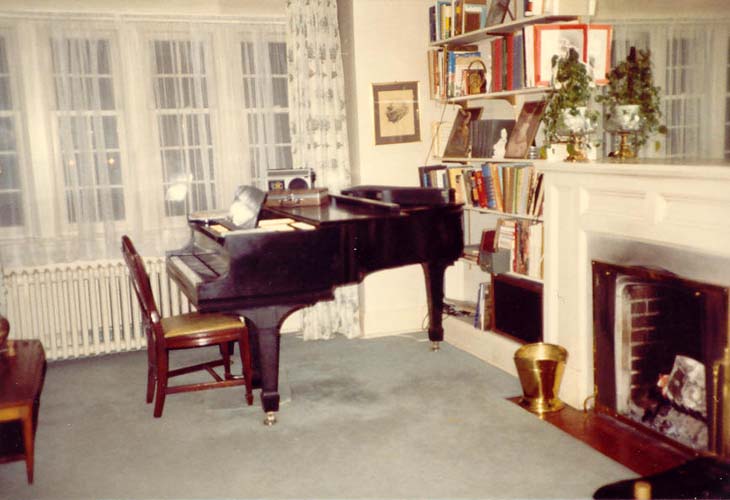
The living room was spacious with a fireplace and mirror over the mantelpiece. Shelving was
installed on either side of the fireplace which housed mostly music, but
also dictionaries and encyclopedias, art and language books, Czech and
German books, and a few records.
The centrepiece of the living room was the 6'2" Model A Steinway piano which was a gift
from Morawetz' parents when he arrived in Toronto in 1940.
Morawetz also set up quite a sophisticated
stereo area. As new technology came to market, he bought the latest in
high-end stereo equipment. The first hi-fi equipment was a vacuum-tube
tape recorder machine that occupied one corner of the living room. This
was soon replaced by a more compact reel-to-reel machine (Morawetz
eventually owned three such machines, which he used to dub tapes of his
concerts which he would then send to artists), record player, cassette
deck, and finally a CD player.
When Morawetz' wife left him
in 1982, taking almost all the furnishings in the house, Morawetz' good
friend Hanja Matějček helped him to refurnish and "redecorate" his home.
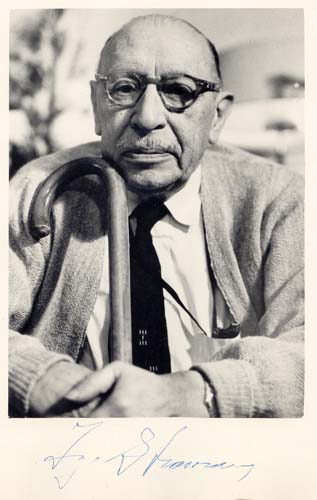
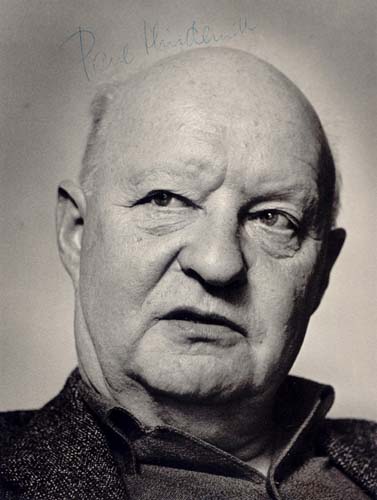
One of the things she convinced him to do is to display many items from his
valuable and interesting musical collection. In his living room, she had signed
photographs of many important people Morawetz had met in his lifetime framed and hung.
In the picture of Morawetz' living room to the right, the photographs are the following:
Benjamin Britten,
Bohuslav Martinu,
Igor Stravinsky,
Vaughan Williams,
Paul Hindemith,
Darius Milhaud and
Jan and Rafael Kubelik. On the far right wall are pictures of former Czech president
Thomas Masaryk,
his son Jan Masaryk, and Jan Masaryk and Richard
Morawetz at the ILO (International
Labour Organization) Conference in 1944.
 Click here for a complete
list of all the items from the collection of Oskar Morawetz.
Click here for a complete
list of all the items from the collection of Oskar Morawetz.
The dining room was the
setting of many formal and informal dinner parties. For large parties, the
centre leaf was inserted and the dining table was moved against the back
windows. Occasionally the Morawetz family's favourite cook, Elizabeth Nagy,
was hired to prepare a special feast.
After his divorce in 1984, Morawetz acquired
the dining suite which his mother had owned for many years before she moved into a
smaller place.
These pictures show
the kitchen after Morawetz' divorce when he had the kitchen enlarged and
renovated. Previously, the eating area was half the size (the left half) and the back
door was about 10' further into the kitchen and led out onto a small back
porch. This porch was not only of little value, but also caused Morawetz'
bedroom which was right above the kitchen to have perpetually cold floors
in the winter!
 |
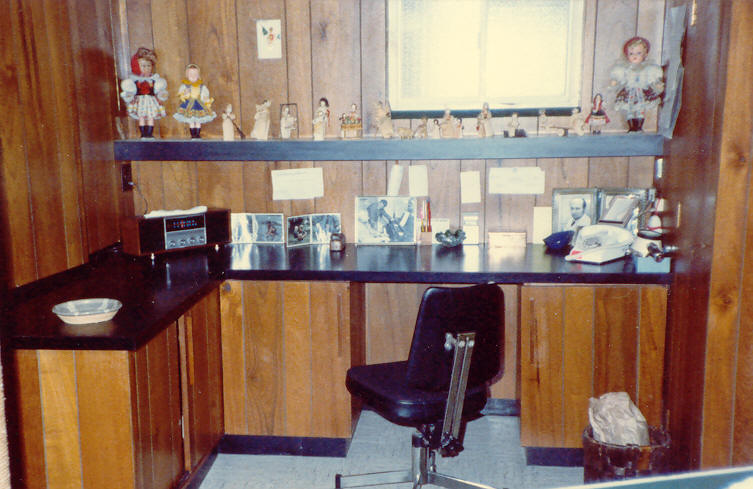
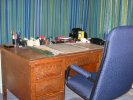
In one of the back bedrooms, Morawetz
installed his bedroom/office. His large oak desk was used for his composing when
he was at home. The swivel chair glided on a custom-made clear plexiglass
form-fitted around the legs of his desk, and the Heintzman upright piano which
stood directly behind it. Between the two, Morawetz had a
little shelving unit with telephone, several metronomes and other books or
papers needed at the moment. The room also had a filing cabinet and a bed,
and the door to the room was of double thickness to provide some amount of
sound barrier between his room and the rest of the floor.
The Heintzman piano (which is now housed at the
Canadian Museum of Civilization
in Ottawa) was the primary instrument Morawetz
used while composing. The running joke was how could he compose on that piano
which was perpetually out of tune and sounded like a fog-horn. In reality,
Morawetz used the piano mostly to try out tempos with the metronome, test
different dynamics or to "feel" the music in his fingers. Most of the actual
composing was done in his head.
Morawetz was fanatic about ensuring his office
was always equipped with every kind of office supply: clear tape in a dispenser, an electric
pencil sharpener, an electric eraser, rulers, hole punchers and a plethora
of pens, pencils and markers.
In his early composing days, Morawetz used
a quill and ink pot to write out his final transparencies. Later, when black
markers became available in various sizes, he switched to that much faster
method of creating his final copies.

 |
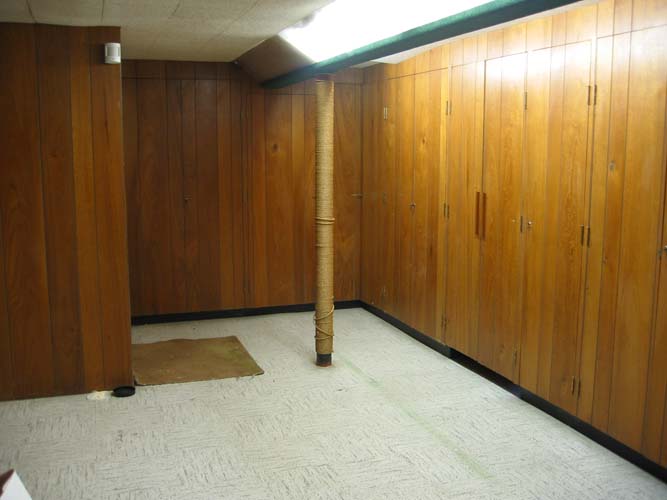
In the late 1960s, the
basement was finished to provide a "rec room" for the children, more storage
space for Morawetz, and an office for his wife. |
Morawetz could never have
enough storage space. When the basement was renovated, it was lined with
cupboards which housed a variety of things related to his musical life.
After many years, when even that was not sufficient, Morawetz added
five filing cabinets in the furnace room to store papers.
In three of these cupboards, Morawetz kept much of his music collection,
consisting primarily of keyboard and orchestral scores, but also operas and chamber music.
His collection also included some very old
editions of facsimile reproductions of great composer's manuscripts. One
of them, a score of Wagner's Die Meistersinger was autographed by
the composer's grand-daughter, Friedlande Wagner, whom Morawetz met in
1977.
In the remaining cupboards and filing
cabinets, Morawetz stored material pertaining to his own professional
life: printed scores of his music, reel-to-reel tapes of performances of
his works, records, concert programs, letters, newspaper clippings,
photos, and other miscellaneous items.
 |
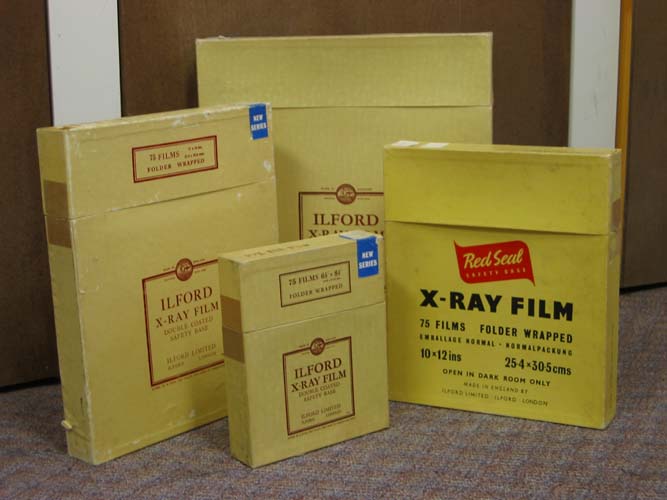
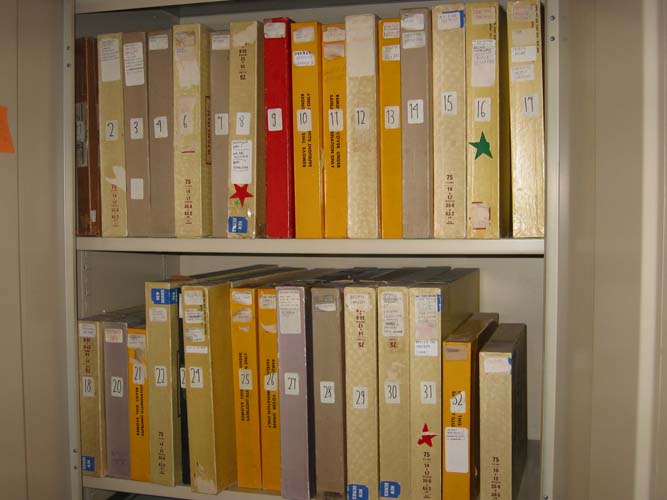
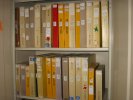
Morawetz treated his books and music with
utmost care. In order to preserve books of great meaning to him, he would
cover them with a home-made book jacket. His library was sorted by
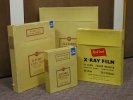
composer and stored in boxes. These were no ordinary boxes. In the early
'40s and '50s, Morawetz learned that hospitals used air-tight boxes
with lids to store their X-rays. After several uses, the hospitals would
discard these boxes, and so Morawetz would make regular trips downtown to
collect as many of these boxes as possible. He soon had a collection of
400-500 such boxes of varying sizes, which he used not only to store printed
music, but precious photographs, transparencies of his own compositions,
and other documents he wanted to preserve.

 |
In 1982, Morawetz separated from his wife, his
son went to live with her, while his daughter had moved out and was attending
university. Now Morawetz took advantage of the extra space in the house and
spread out even further. Additional filing cabinets, a bookcase and a desk were
purchased and his son's bedroom became an office. The large cabinet housed all
his original transparencies to his compositions, which he yet again kept for
safe-keeping in the hospital X-ray boxes, carefully numbered and labelled.
|
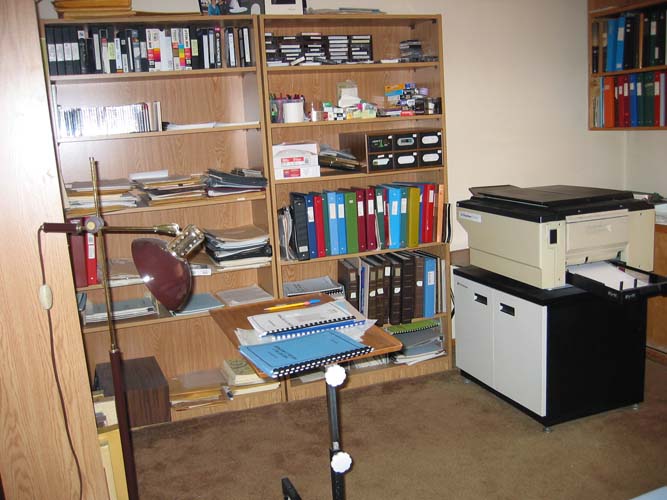
His daughter's ex-bedroom
acquired four new bookcases and a photocopier, and it is from here that
Morawetz ran his own "publishing" business, Aeneas Music. His trademark
printed music appeared spiral-bound, with his name and the title of the music,
and Aeneas Music on the front cover. |

 |
In March 2002 Morawetz moved to a retirement home. His house was sold in February 2003.