First Lessons
Morawetz' elder brother, Herbert, was the first to begin music lessons.
Morawetz pestered his parents to let him take lessons as well. One day when Morawetz was 6 years old, his mother called him and said:
"Oskar, come upstairs. There is a lady here who will show you how to play the
piano." He went upstairs, believing that
learning to play the piano would be like learning a card game; the teacher
would show him how to play, and then he would be able to play the piano.
Thus began his piano lessons...
Following in the footsteps of his elder
brother Herbert, he started piano lessons with Mrs. Ambroz, the wife of the
forester at the summer residence in Světlá. It was soon clear which of the two
brothers had the musical talent in the family. Morawetz quickly progressed in
his lessons, until one day Herbert threatened: "if Oskar surpasses me in his
piano grade, then I will quit". Soon after Herbert dropped his musical studies.
There is an amusing anecdote from the time of those early lessons. Their
mother had bought a music dictionary and a book of piano duets, titled Frère
et Soeur. Morawetz declared he was going to look up "Hanon" in the music
dictionary. His elder brother scoffed: "You won't find him because he never
wrote any real music - only all those stupid exercises." Nevertheless Morawetz
found Hanon in the dictionary. Morawetz then decided he would look up "Frère et
Soeur", at which point Herbert laughed: "Don't be ridiculous! That won't be in
the dictionary" to which the young Morawetz replied: "That's what you said about
Hanon!"

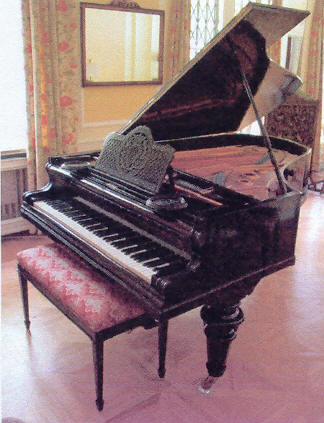
Friedrich Ehrbar piano |
There were two pianos in the castle in Světlá. Morawetz enjoyed making music
mostly in the Great Hall where he played on a grand piano dating from 1885-1890
from the Friedrich Ehrbar Company in Vienna. After the war, Morawetz' father
arranged for the Canadian ambassador to visit Světlá and see if there was anything left in the
castle. Almost everything was gone, except for this piano, which the ambassador
decided to buy for the Canadian Embassy in Czechoslovakia.
It still resides today in
Hadovka, the Canadian Embassy Residence in Prague.
Apart from
practising for his lessons, Morawetz loved to sight-read. He would read any piano
music he could get his hands on. This habit frustrated his piano teachers who
complained to his parents that he should be working on his technique and
perfecting his assigned pieces, rather than wasting time reading through music
that was too difficult for him. At annual student recitals, the teachers wanted
to be able to boast how well their students could play through a piece perfectly
by memory, and were unimpressed that Morawetz had played through a literature of
a hundred pieces, and was unable to perfect just one.
 |
In the early 20th century, recording technology was still quite primitive.
However Morawetz was delighted when, for his birthday one year, his parents gave
him a complete opera on record - or rather, about 30 records. Morawetz would
wind up the gramophone, listen to the 3 minutes of music that fit on one side of
the record and then rush to wind it up again as the gramophone wound down, and
the music got slower and slower. Years later, with the advent of 33rpm records,
and then reel-to-reel tapes, cassettes and CDs, Morawetz laughed at the
determination he had to listen to music performances in such a frustrating
manner.
The way to learn the music repertoire in those days was to play it. Morawetz
was thrilled when, in addition to original piano music, he received piano
reductions of operas and symphonies. Such editions are no longer printed, as
accessibility to music on CD or attending live performances has increased.
However, by being forced to play through a piece, Morawetz gained a familiarity
with the composition that is hard to achieve through a few listening sessions.
In this manner, he became familiar with a vast amount of the musical
literature.
His hunger to learn more of the music repertoire lead him to score reading.
He became so proficient at it, that he could look at a score and hear the music
in his head. Reading scores to Morawetz was like reading a book to most people.
He would often take a score to school and read it under the desk when the
teacher was not looking.
In his later years, as professor and composer, Morawetz was a walking musical
dictionary. One could play the first two or three notes of a theme from any
piece and he could identify the composition. He himself turned it into a game,
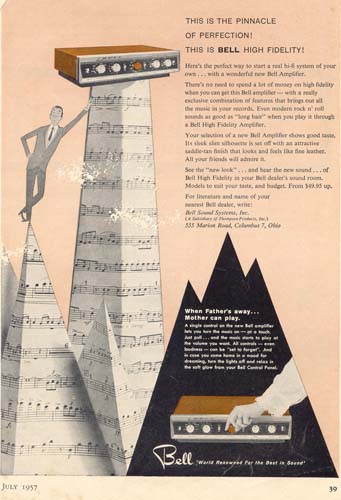
and began a collection of musical excerpts printed in unusual places: a perfume
advertisement, a piece of wrapping paper, a greeting card,... His only criteria
was that the music had to be "real" music, and not some artist's rendition of
musical notation. Here are some samples from Morawetz' "musical scrapbook", clippings from
various printed articles containing music which he could identify:
His brother Herbert remembers an incident when they were talking, and a radio
started playing some music. Morawetz abruptly interrupted the conversation with
"Shhh! I want to listen." After a few seconds of listening to the music, Herbert
asked his brother if he had ever heard the music before, whereupon Morawetz
replied: "No. But I read the score some 10 years ago."