Unfinished Work
In Morawetz' later years, he began to do more and more revisions of his
works. Usually the revisions were made after the première of a composition,
where he would make changes based on what he had heard in the performance or
on suggestions of the soloist(s).
With the onset of depression in May 1995, Morawetz found it more and more
difficult to concentrate. At the time, he was making revisions to his Concerto for Bassoon and Orchestra
which had premièred the year before. He was also in the midst of proofing his
new work, Fantasia for Violin and Chamber Orchestra,
which was an orchestration and modification of his Sonata No. 2 for Violin
and Piano. The Fantasia was scheduled to première on Oct. 2nd of that
year with violinist Ivan Zenaty and Nurhan Arman conducting Symphony New
Brunswick. However, Morawetz battled with the effects of depression that whole
summer and was unable to finalize the work, and so the Fantasia was never
actually premièred. Morawetz never composed again.
And what would Morawetz have created next, had he been able to keep on
composing?
In 1994, he was awarded a Toronto Arts Council grant to write a new
piano piece. Here is an excerpt from the application form for this grant, where
he describes the new work he wanted to compose:
The idea to write a fantasy based on the style of songs of Sephardic
Jews was suggested to me by Alma Petcherski, an excellent Argentinian pianist.
She moved from Buenos Aires to London, England where she made several
recordings and played often on BBC. Two years ago she settled down in Toronto.
She acquainted me with the great wealth and originality of the music of
Sephardic Jews of Spain. Their music comes from the time prior to the
annihilation or escape of the Sephardic Jews from the horrors of the Spanish
Inquisition.
My intention is to write a major work for piano which would be based on
characteristic rhythms of Sephardic songs without using the actual melodies.
This approach could best be compared with a number of works by Bartok, where
the style is clearly Hungarian without quoting any particular songs.
To my knowledge, there has never been a composition written based on
Sephardic tradition. I feel that this work may be, by its style and content,
of great interest to many pianists.
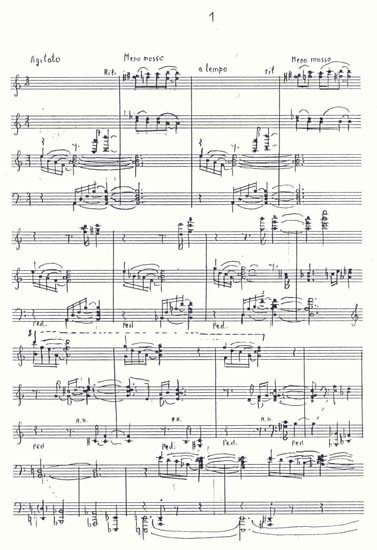
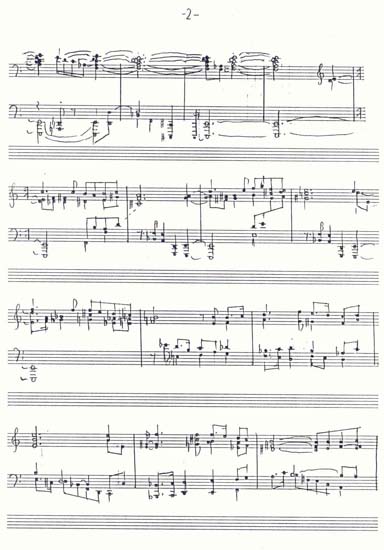
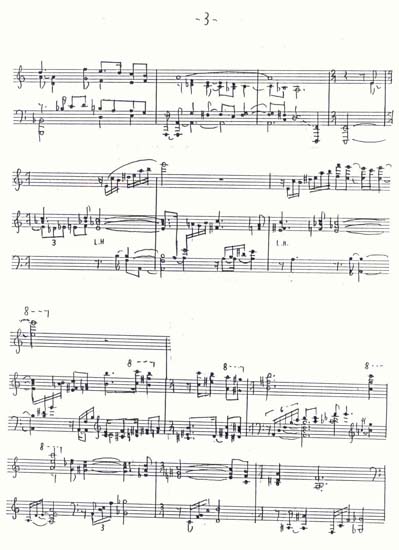
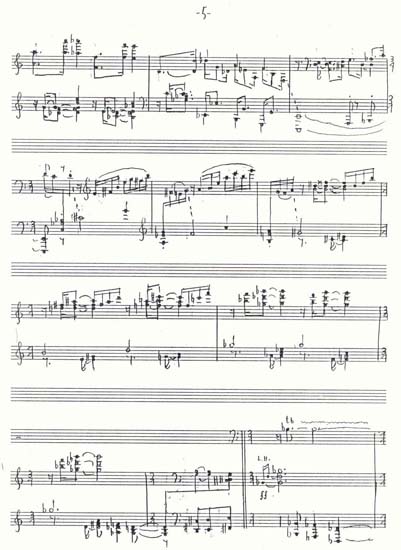
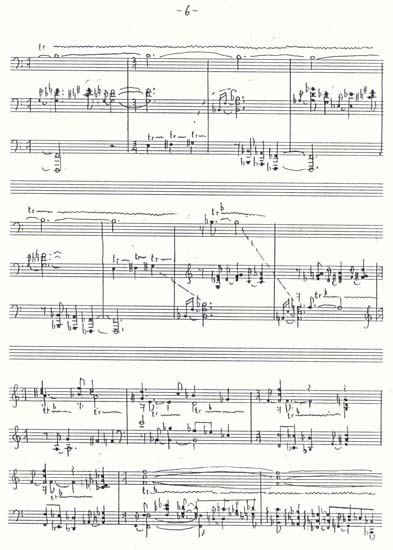
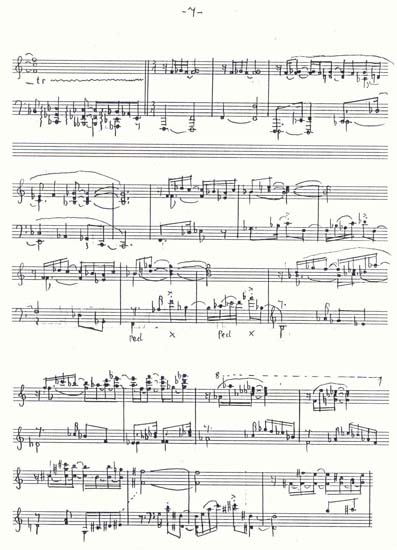
Only initial sketches remain of this work: