Musician Friends and Acquaintances
Morawetz met a great number of well-known musicians, both in Czechoslovakia
as a young music student, and as a pianist and composer in Canada. Many of them
became lifelong friends and several of them have performed Morawetz'
compositions. This page contains the stories about, and testimonials from, a
variety of these musicians over his lifetime.
| Click on the name of the
musician below to go directly to the story of Morawetz' connection with
them. |
 Click here to see more photos of Morawetz' musical acquaintances.
Sergiu Prokofieff, Jan Novák
In Prague, Morawetz met many Czech musicians who would go on to make
distinguished
careers. At a chamber concert he attended with his brother John around 1930, he heard
Prokofieff perform at the piano. He also met the composer Jan Novák whom
Morawetz thought was an excellent composer and whose music he loved, and yet he was
always surprised that Novák's music is hardly ever performed.
Rudolf Firkušný

Morawetz and Rudolf Firkušný, 1946 |

Morawetz and Firkušný,
1993 |
Morawetz met Rudolf Firkušný at a party. As the pianist was already famous in Prague, Morawetz was at first too shy to say much. However they
became lifelong friends, and it was Firkušný who later premièred Morawetz'
Scherzo at Toronto's Massey Hall.
Click here to read a humorous story with Morawetz
and Firkušný.
On Firkušný's
80th birthday, Morawetz created a humorous musical greeting card for the pianist.
Click here to
view Morawetz' 80th birthday greeting to Firkušný.
The last time the two met was at a gala concert in Prague in 1993 celebrating
the 100th anniversary of the première of Dvořák's New World Symphony. Morawetz' transcriptions of Dvořák's Slavonic Dance in
E- and Humoresque in G-flat were on the program, and Firkušný performed at
the same concert.
Antonin Dvořák
Although Morawetz never met Dvořák, his piano teacher in Prague, Karel
Hoffmeister, had been good friends with Dvořák, and so Morawetz learned many
stories about Dvořák from his professor. On Oct. 12, 1988, CJRT-FM radio
broadcasted Paul Robinson interviewing Morawetz about Dvořák. Here are excerpts
from that broadcast:
 Oskar, tell me
about growing up in Czechoslovakia, about the legacy of Antonin Dvořák,...
Oskar, tell me
about growing up in Czechoslovakia, about the legacy of Antonin Dvořák,...
So I was very
fascinated to see that I know quite a few people in Prague who saw Dvořák
conducting, heard him teaching, and...
The person that
really helped him out of the terrible poverty was Brahms...
The thing which
is so amazing about Dvořák, not only that he was so versatile, but he wrote in a
speed which you can compare...
If you ask
somebody what has the New World Symphony in common with Dvořák's cello
concerto...
You know, he was
a very intelligent, a very quick person, but in some things...
Bohuslav Martinu, Leoš Janáček

Bohuslav Martinu |
Firkušný was one of the first pianists to
perform works by Bohuslav Martinu and Leoš Janáček, both of whom Morawetz also
met in Prague. Firkušný was a great supporter of Janáček, who had taught him
piano and composition, and told Morawetz many stories about him.
As Janáček did not really became famous until the last five years of his
life, Morawetz recalls how in 1928 his mother told him with great disappointment
that the German Theatre in Prague (the Smetana Theatre today) had changed its
program, and instead of Aida it would be performing Janáček's Katya
Kabanova. However the opera was tremendously successful, and Janáček was
called to the stage. Morawetz remembers being greatly impressed with seeing a
composer in the flesh. The conductor was William Steinberg, and when Steinberg later
conducted a couple of Morawetz' songs in
Philadelphia, Morawetz told Steinberg how he still recalls the wonderful
performance he gave of Janáček's opera more than twenty years earlier. When Janáček's operas were finally being
introduced to Canadian audiences, Morawetz met the conductor of a Canadian Opera
Company Janáček production, who was quite overcome that Morawetz had met the
great Czech composer, and wanted to learn more about him.
Josef Suk

Josef Suk, 1934 |
Morawetz loved the music of composer Josef Suk. His friend, pianist Firkušný, told him
a story about Suk: Suk had a student who "knew everything better". Once Suk told the student that
his orchestration was all wrong, took out a score of Meistersinger and analyzed it
for him. The student said: "But professor, I don't want to compose the way
Wagner did", to which Suk replied: "Don't worry about that, genius is not contagious."
When a visitor to Morawetz'
birthplace in Světlá mentioned that he had recently photographed Suk, Morawetz
asked if he could have a copy of the photograph. After Morawetz had moved to
Prague, he attended a series of four concerts of symphonic poems by Suk
conducted by Václav Talich, the conductor who brought international recognition
to the Czech Philharmonic. At one of these concerts Morawetz met Suk and asked
him to autograph the photograph. Sadly Suk died a year later, and
Morawetz believes he has the latest photograph taken of him. When Morawetz fled
Europe during the war, he took this photograph with him and later sent a copy
to Suk's grandson, the violinist Joseph Suk.
Erich Kleiber
When Morawetz was 16 years old, he was introduced to the conductor Erich
Kleiber, who often conducted in Prague. Kleiber asked Morawetz what he wanted to
study, and Morawetz replied, as was his belief at the time, that he wanted to
become a conductor. Kleiber then gave Morawetz the following advice: "The best
thing you can do is to take a position in a third class opera house. That was my
best training. A big opera house won't accept you anyway. In a small opera
house you can experiment with the orchestra, and if you try something that
doesn't work, you can do something different next time. With a big orchestra,
you won't last long."
George Szell
A few years later Morawetz was introduced to George Szell who was a very fine
musician, but very rough with people.
Click here to read about Morawetz' meeting
with George Szell.
Rafael Kubelik

Jan and Rafael Kubelik |
Morawetz met the conductor Rafael Kubelik at an informal chamber music
concert given by a mutual friend. Thereafter he saw Kubelik at
rehearsals of the Czech Philharmonic which he regularly attended. In those days
when music recordings were not widely available, young musicians studied scores
but could only imagine how the music actually sounded until they heard a live
performance. If a composer introduced a new colour or effect, it could be years
before a repeat performance of the work would allow a musician to hear that new
technique again. Thus Morawetz attended these orchestral rehearsals eagerly to learn the
different colours and capabilities of the instruments, and how two, three or
more different instruments
sounded when played together.
Click here to listen to
Morawetz describe his experiences observing orchestra rehearsals.
At one of Kubelik's concerts, there was a
photograph in the program of the violinist/composer father, Jan, and his son
Rafael Kubelik. Morawetz kept the
program and later had both Kubeliks sign it. This is another memento he carried with
him through Europe during his escape to North America.

Morawetz and Rafael Kubelik,
New York 1974 |
Rafael Kubelik made a huge impression on Morawetz, both as a musician and
a friend. Originally trained as a violinist, Rafael Kubelik was appointed as the
youngest conductor of the Czech Philharmonic when he was in his early twenties.
When Morawetz asked him once who accompanied his violinist father on his concert
tours, Kubelik answered that he did. Morawetz was astonished that Kubelik was
not only an excellent pianist, but that he was completely self-taught. A further
surprise occurred when Kubelik came to visit Morawetz in Světlá during the summer
holidays and showed him the score of a symphony he had composed. Morawetz was
astounded that Kubelik also composed, and was told that his predecessor at the
Czech Philharmonic, Maestro Talich, had taught him composition. When Kubelik
began being successful, he had the feeling that Talich was a little jealous, a
common occurrence between professor and talented pupils. One time Kubelik said to
Talich: "There is this passage in Don Giovanni, and no matter how hard I
try, I can't get the musicians to play together. How do you manage it?"
Whereupon Talich smirked and replied: "I bet you'd like to know"! It was Kubelik
who encouraged Morawetz to become a conductor.
Once Kubelik stopped by at the Morawetz family apartment in Prague. As Morawetz was not home,
Kubelik left the score of a lullaby he had
composed, on which he had written: "Dedicated to my friend Oskar Morawetz."
Regrettably this score did not survive the Gestapo raid on the apartment in the
spring of 1939.
After Morawetz had emigrated to Canada, he saw Kubelik on several occasions.
In 1949, Kubelik was guest conducting the Montreal Symphony while Morawetz was
in Montreal for the filming of Forbidden Journey, a movie for which he
had written the film score. In 1952, Kubelik performed Morawetz' Carnival
Overture while he was music director of the Chicago Symphony. Morawetz was
booked to stay at a hotel in Chicago, but Kubelik objected: "Surely you won't
stay at a hotel when you have an old friend here", and so Morawetz moved in for the duration of his stay.
He saw Kubelik periodically again on
several occasions, including in New York in 1974, in Munich in 1977, and the
last time at the Prague Spring Festival in 1990.

Morawetz, Susan Douglas, Rafael Kubelik and Jan Rubeš, Montreal 1949. |
Jan Rubeš
Although baritone Jan Rubeš was also a native of
Czechoslovakia, he and Morawetz did not meet until they were in Canada. However
Rubeš' yearning to speak to someone in his own language, and finding another
musician no less, quickly formed a strong bond between them. They
became close friends and in the early years after their arrival, Morawetz
accompanied the singer in many concerts both in Toronto and on a tour in New
York. They remained life-long friends, and Morawetz accompanied Rubeš in several
Toronto Czech concerts in the 1980s and 1990s.
Click here to read Jan Rubeš' Testimonial to
Morawetz.
Glenn Gould
After Morawetz had emigrated to Toronto, he continued his
music studies at the University of Toronto, under the tutelage of his piano
teacher, Albert Guerrero. It was during this time that he met the pianist
Glenn Gould. Albert Guerrero once hosted a party for his gifted pupils, and
among his guests was the 13-year old Gould. Morawetz immediately felt that he
had found a soul mate, someone who knew as much about music as himself, and with
whom he could discuss any musical topic. They became good friends, and talked on
the phone almost daily. One summer, Gould's parents invited Morawetz to spend
part of his holiday at their cottage.
Despite their close friendship, Morawetz, like so many others, was mystified
by Gould's radically different interpretations of music. He recalls Gould's
interpretation of a Brahms concerto which took twice as long as usual. When
Morawetz asked him why he plays things so differently, Gould replied: "If I
played things the same way as everybody else, there would be no point." When
Gould recorded his Fantasy in D in the early 1950s, Morawetz asked if the
pianist would play it for him before the recording session. Gould continually
refused his requests, assuring Morawetz that he had analysed the piece and
understood exactly how it should be interpreted. Morawetz pleaded and finally a
few days before the studio session, Gould relented on condition that "you do not
say anything at all". Morawetz reluctantly accepted this stipulation, and
listened silently from beginning to end with increasing unease: the tempos and
dynamics were not as written, notes were accented in the wrong place, and
Morawetz hardly recognized his own composition. When Gould finished playing he
turned to him and asked: "so, what do you think?" Morawetz began: "I wrote this
to be a main theme, and you play it as a subsidiary theme." After pointing out
several other problem areas, Gould finally turned to the composer and declared:
"The trouble with you, Oskar, is you don't understand your own music!" In spite
of this incident, the two musicians remained friends, and Gould attended
Morawetz' wedding a few years later. Nevertheless, Gould never performed anything
else by Morawetz.
 Letter from Glenn Gould to Morawetz, Jan. 3, 1952.
Letter from Glenn Gould to Morawetz, Apr. 28, 1952.
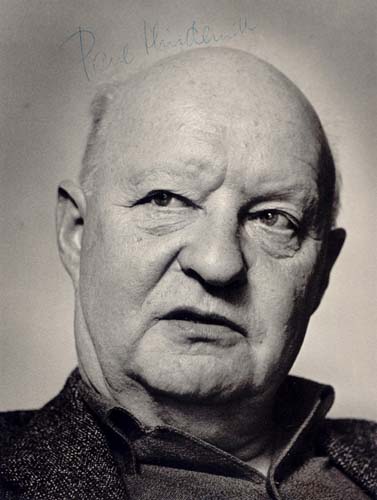
Paul Hindemith

Paul Hindemith |
Composer Paul Hindemith was also a fine viola player, and Morawetz heard him
once in a Toronto performance. Afterwards he met the musician and had him
autograph his photograph. The two began to talk about composing, and Hindemith
mentioned that he composed everything away from the piano. Morawetz concluded
that this explained why he felt the music of Hindemith was not as exciting as
that of Prokofiev or Ravel. He felt that if Hindemith wrote the same music for
a different instrument, it would sound the same. Morawetz used the piano as an
emotional outlet, and felt that his music was always more exciting when he had
"tested" it on the piano.
Benjamin Britten

Benjamin Britten |
Benjamin Britten's Peter Grimes was a huge success at its 1945
première. Morawetz did not know much about Britten at the time, but listened to
the music and was deeply moved: he had finally found a 20th century composer he
could admire. When Britten first came to Toronto, Boosey & Hawkes arranged to
have Morawetz' copy of the opera score signed by Britten and Peter Pears, who
sang the leading role.
A few years later, Morawetz happened to be at the CBC when Britten
was in Toronto looking for someone to play the role of Billy Budd in his
newest opera. After the auditions which were held at the CBC, Britten was in a
big rush to get downtown and a taxi was slow in coming, so Morawetz was asked if
he could give the composer a lift. In the car, the shy young Morawetz initiated
the following conversation,
demonstrating Britten's friendliness and modesty:
Morawetz: Mr. Britten, you will be interested to know that just three
weeks before you came here, the CBC played your piano concerto.
Britten: Did they play all 5 movements?
Morawetz: (embarrassed, because he thought piano concertos only have four
movements) I think they only played four; I didn't know there was a fifth.
Britten: I took one movement out.
Morawetz: Why?
Britten: Because the one I took out was the most embarrassing of the
five.
Morawetz saw Britten again at Expo '67 in Montreal where two of Britten's
operas were being produced. He brought five of Britten's scores, and asked
him if he would write something.
By the time Britten had signed the fourth score, he exclaimed: "Oh, you have so much of my music. How
is it possible?" Morawetz replied: "For my art, I really think you are the finest composer born
in this century." The modest Britten countered: "Well, that's very nice,
but don't tell any other composers or you will make lots of enemies".
Anton Kuerti

Anton Kuerti and Morawetz,
Parry Sound 1982 |
One of Morawetz' most enduring close friends is the Austrian-born pianist,
Anton Kuerti whom Morawetz met early on in the pianist's career. When Morawetz
won the Montreal Symphony's 1962 competition for his piano concerto, he
requested the young pianist to be the soloist. Kuerti received rave reviews for
his performance of Morawetz' concerto, which he played by memory. He remained a
loyal supporter of Morawetz' music, giving the première of his Suite for Piano,
and performing other of his piano works. When Kuerti became involved with the
Greenpeace Save the Whales campaign in the 1980s, he asked Morawetz to write a
short composition for a book celebrating whales in various art forms. When he
founded the Parry Sound Festival of the Sound in 1980, Morawetz stayed at his
cottage in Parry Sound during the music festival. Kuerti and Morawetz have
remained steadfast friends for many years.
Click here to read Anton Kuerti's Testimonial
to Morawetz.
In 2012, five years after Morawetz passed away, Kuerti shared his music and memories
on CBC's program This is My Music, and spoke fondly of his friend, Oskar.
Click to hear Anton Kuerti's recollections
of Morawetz.
Zubin Mehta

Zubin Mehta |
Morawetz first met Zubin Mehta when the conductor awarded
his Piano Concerto first prize in a nation-wide competition sponsored by
the Montreal Symphony. Mehta liked Morawetz' composition so much that he
asked him to send him more works for possible performance with the Montreal
Symphony. Morawetz thought the conductor was just being polite, and did not
comply with Mehta's request. A few years later however, Morawetz met Mehta
backstage at Massey Hall in Toronto after a guest performance by the Montreal
Symphony, and Mehta asked Morawetz once again to send him some of his works.
This time Morawetz complied and sent him his recently completed Sinfonietta
for Winds and Percussion. He was delighted when he was informed a few days
later that the Montreal Symphony would perform the work in the last concert of
the season, a work which later won the Critics' Award for the International
Contemporary Music Competition in Italy.
At one of the rehearsals for which
Mehta had programmed Morawetz' composition, he was also conducting Beethoven's
9th symphony. During a break, Mehta asked Morawetz how to say the opening
choir's words, "Freude, Freude" in Czech. Morawetz replied that "Freude" (Joy)
was translated "Radost" in Czech. Thereafter, whenever Mehta greeted Morawetz,
he always effusively declared: "Radost! Radost!".
Click here to read Zubin Mehta's Testimonial
to Morawetz.
Lawrence Leonard

Lawrence Leonard, 1974 |
Morawetz' From the Diary of Anne Frank was a CBC request for a new
5-minute orchestrated song for Lois Marshall to sing with the Toronto Symphony.
The 1970 première with conductor Lawrence Leonard occurred against all odds.
Morawetz had already decided to use words from the text of Anne Frank's diary,
but found it very difficult to leave out so many of Anne's moving sentences. The
work grew in length until finally it was 19 minutes long. When Morawetz had
almost finished the work, he realized he would have to get permission to use the
words and waited an agonizingly long time before obtaining this permission. Then
shortly before the performance, the orchestra members went on strike, and one
rehearsal was lost. Furthermore, the scheduled program had a number of
contemporary works, which generally require more rehearsal time.
In desperation, Morawetz asked Leonard: "How are you going to do it?" Leonard
calmly instructed Morawetz: "Don't worry. You listen to the rehearsal, but don't
interrupt; just make notes about anything you don't like." After the rehearsal,
they went to Leonard's hotel and Morawetz went through all his notes. Leonard
took out a lined piece of paper and made a series of notes, such as: "flutes: 2
bars after 16, a little more sound." At the next rehearsal, he gave a copy of
the notes to each of the orchestra members and gave them 3-4 minutes to read
them over. Then they played through the work and Morawetz couldn't believe it:
it was like a completely different piece. Morawetz owed the successful
interpretation of his new composition to Lawrence Leonard.
Louis Quilico
When the Canadian Constitution was transferred from Great Britain to Canada
in 1982, there was an official ceremony to which Canadians of all walks of life
were invited. Morawetz attended, as well as his friend, the baritone Louis
Quilico. The invitation was accompanied by all sorts of instructions about
protocol: when to sit and stand, no photographs to be taken, how to address the
Queen and Prince Philip, and not to speak to the Queen unless she addressed you
first. Louis Quilico was a great joker and did not take official directives very
seriously. After the official ceremony was over, Quilico asked Morawetz: "Oskar,
did you by any chance watch Prince Philip while they were singing O Canada?"
When Morawetz said he hadn't noticed the Prince in particular, Quilico remarked:
"Too bad you didn't watch. He obviously doesn't know the words to O Canada!"
After the ceremony, the guests were standing in two rows on either side of an
aisle down which the Queen and Prince Philip walked. Morawetz noticed that the
Queen seemed very shy, and generally stopped to talk only to young people. Thus
Morawetz decided instead of hoping for an opportunity to speak with the Queen,
he would walk behind the two rows so that he could hear all the conversations
she was having. When she saw Quilico, she said: "Oh, I saw you already once
today", referring to the concert that had taken place earlier. Completely
ignoring all protocol, Quilico blurted to the Queen: "I was watching your
husband when we were singing O Canada, and I have a feeling that he was
just mouthing the words!" The Queen was shy, but had a very quick answer: "Yes,
he loves to sing in the shower, and sometimes he even sings in tune!".
Yo-Yo Ma

Morawetz and Yo-Yo Ma,
in Morawetz' home, 1977 |
Morawetz was introduced to Yo-Yo Ma by his friend, Anton Kuerti, when the
cellist was only 20 years old. Morawetz had never heard of him before, but Ma
asked Morawetz to send him one of his compositions. It was not until 1991 that
Ma finally had an opportunity to perform Morawetz' Memorial to Martin Luther
King with the Boston Symphony Orchestra. By this time, Yo-Yo Ma was a big
name, and yet he was still affable and unpretentious as demonstrated by the
following anecdote:

Yo-Yo Ma and Morawetz, Boston 1991 |
As was his usual custom, Morawetz travelled to Boston to attend the
rehearsals as well as the performances of his compositions. At the first
rehearsal, before beginning to play, Ma turned to Morawetz and said: "Oskar, I
will be quite frank with you. I haven't really had a chance to brush up the
piece, so when I play today, I will probably make several mistakes, and next
time I'll make fewer, and hopefully at the performance I won't make any. Now you
sit next to me, and if I do something you don't like, you just tap on my
shoulder and I will stop and you tell me what you would like differently."
Morawetz found this speech incredible: most conductors do not want their
rehearsals interrupted, and often don't want to hear any comments. The rehearsal
began, and Ma played gorgeously, but after 30 or 40 bars, he stopped the
orchestra and turned to Morawetz: "I have already played about 40 bars and you
haven't told me anything you would like differently." Morawetz said: "But what
should I say? It sounds terrific, wonderful." To which Ma replied: "Do you
really mean it, or are you just saying it to be nice to me?"
The program also included Beethoven's 9th symphony. At the performance, Ma
came on-stage for the Beethoven piece, and sat in the last desk of the cello
section to play the symphony!
In 1993, Yo-Yo Ma was engaged to play the Memorial almost concurrently
with the Toronto Symphony and the New York Philharmonic with Kurt Masur
conducting. With seemingly limitless energy, Ma travelled back and forth between
Toronto and New York for the intermingled rehearsal and performance dates, and
played beautifully at both venues.
Vladimir Ashkenazy

Morawetz and Vladimir
Ashkenazy, 1995 |
Morawetz was in Israel in 1976 to attend a performance of his From the
Diary of Anne Frank with the Israeli Philharmonic in Tel Aviv conducted by
Uri Segal. During a break in a rehearsal, Morawetz noticed that the pianist
Vladimir Ashkenazy, who was to perform at a concert a few days later, was in the
next room. Uri Segal told Ashkenazy that he should come to hear the orchestra
perform Morawetz' work. Ashkenazy's response was "I would love to, but I have to
tell you I have no use for this avant-garde music." However Segal challenged
him: "Just wait, I think you will be surprised, and will like it." Sure enough,
Ashkenazy did attend the performance and afterwards told Morawetz how much he
had enjoyed his work. Morawetz was not sure if the pianist was sincere or if he
was just paying the standard compliment to a fellow artist.
Many years later, Morawetz met Ashkenazy again in Cleveland. Ashkenazy not
only remembered Morawetz and the performance of his Diary so many years
before, but promised that he would one day conduct the work himself. Indeed, in
1995, Ashkenazy conducted the Diary with the Cleveland Orchestra, in the
50th anniversary year of the end of the Second World War.
Click here to read Vladimir Ashkenazy's
Testimonial to Morawetz
Testimonials
During the course of his 50-year composing career, Morawetz met many fine
musicians. Below are further testimonials to Morawetz' outstanding musical
career, written by some of the musicians who have performed his compositions.
Mezzo, Judith Forst
Pianist, Angela Hewitt
Pianist, Margaret Ann Ireland
Pianist, Anton Kubalek